
Copper View Eye Care + Aesthetics provides comprehensive eye exams for adults and children in South Jordan, Utah. An exam checks your prescription, eye teamwork, eye pressure, and the health of the front and back of the eye, and can include widefield retinal imaging with the ZEISS CLARUS 500. Most patients can book online, and many vision insurance plans are accepted.
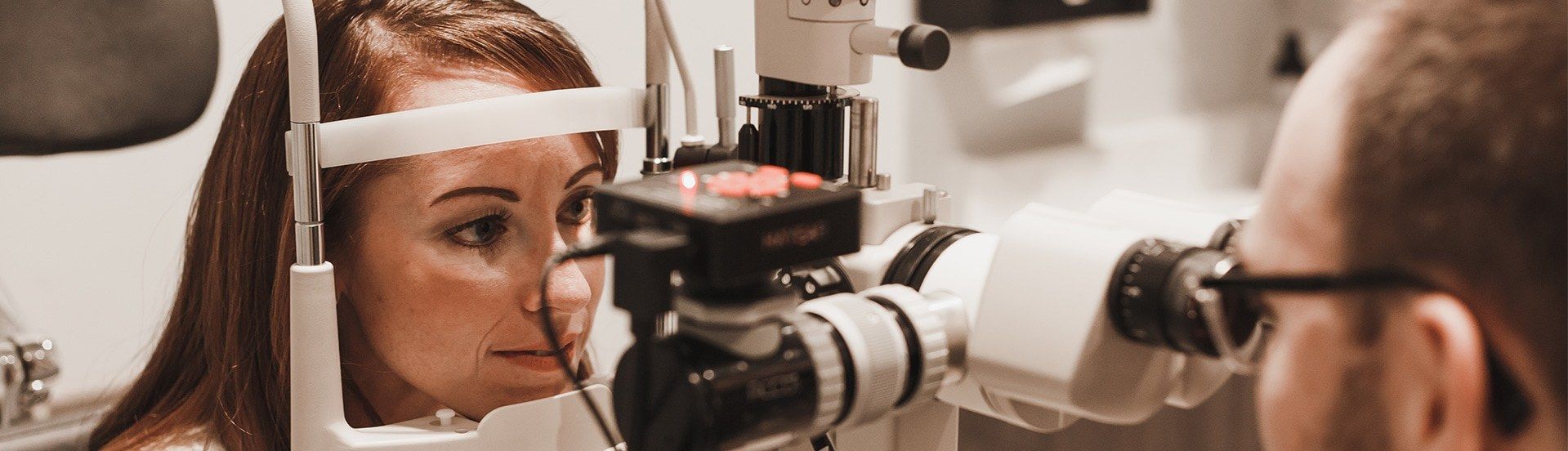
Coming in for a regular eye exam
Copper View is well known for dry eye and specialty lenses, but most of our day is yearly exams, updated prescriptions, new glasses, and contacts. You don’t need a complicated eye problem to see us. Families, students, first-timers, and people who haven’t had an exam in a decade are all welcome.
What a comprehensive exam includes
Every exam is tailored to your age, history, and symptoms, and commonly includes:
- Health and vision history. Your concerns, medications, health conditions, and family eye history.
- Visual acuity. How clearly you see at distance and near.
- Refraction. Fine-tuning your glasses or contact lens prescription.
- Eye teamwork and focusing. How your eyes move and work together, which matters for reading, screens, and headaches. If alignment strain or migraine-related light sensitivity is a concern, ask about Neurolens or Avulux migraine lenses.
- Eye pressure. Measured with an iCare rebound tonometer, with no air puff.
- Front-of-eye exam. A slit lamp look at the lids, cornea, lens, and tear film, including early signs of dry eye.
- Retinal exam and imaging. A look at the optic nerve, blood vessels, and retina, often with widefield imaging.
Every exam ends with a plain-language summary of what we found and what, if anything, to do next.
Widefield retinal imaging
We use the ZEISS CLARUS 500 to capture high-resolution, widefield images of the retina. These images help us look for signs of glaucoma, diabetic retinopathy, macular degeneration, retinal holes, and other conditions, and they let us compare your eyes from year to year.
Imaging does not replace dilation in every situation, but it gives a broad, detailed record of your retina and makes it easier for you to see what we see.
More than glasses: what an exam can catch
Many serious eye conditions cause no symptoms early on. A comprehensive exam can reveal:
- Glaucoma, which can quietly damage the optic nerve. See medical eye care and glaucoma.
- Diabetic eye disease, sometimes before blood sugar problems are diagnosed. See diabetic eye exams.
- Macular degeneration and other retinal changes. See macular degeneration.
- Cataracts, which develop gradually. See cataract care.
- Dry eye and meibomian gland dysfunction, a frequent cause of burning, watering, and fluctuating vision. See the Dry Eye Center.
Exams for kids
Children can’t always tell you they can’t see well. We see kids for comprehensive exams and help families with glasses, contacts, and orthokeratology for nearsighted children. See kids and pediatric eye care.
What to bring
- Your current glasses, and your contact lens boxes or prescription if you wear them
- A list of medications and supplements
- Your vision and medical insurance cards
- Sunglasses for the drive home in case you are dilated
New patients can review patient forms before the visit.
When it’s not routine
If you have sudden vision changes, a painful red eye, new flashes or floaters, or an eye injury, don’t wait for a routine exam. Call us at (801) 923-3935, or see urgent eye care.
Frequently asked questions
How long does a comprehensive eye exam take?
Plan on about an hour, including check-in, testing, time with the doctor, and choosing glasses or contacts if you want them. Dilation, when needed, adds time.
Do I need to have my eyes dilated?
Not always. Widefield retinal imaging gives a broad view of the retina and can sometimes reduce the need for dilation. Dilation is still recommended in some situations, such as diabetes, new floaters or flashes, or findings that need a closer look. We will explain what we recommend and why.
How often should I get an eye exam?
Many adults do well with an exam every one to two years, and yearly exams are common for people with diabetes, glaucoma risk, contact lenses, or other eye conditions. Children should have regular exams as they grow. See how often adults need eye exams.
Is a contact lens exam different?
Yes. Contact lenses require additional measurements and a fitting, so a contact lens exam includes the comprehensive exam plus a lens evaluation. See contact lens exams.
Will my vision insurance cover the exam?
Routine eye exams are commonly covered by vision plans. If your visit is for a medical problem, such as an eye infection or dry eye, it may be billed to medical insurance instead. See insurance for details.